-
-
Downtown
Sinboksaji Temple Site
The site of Sinboksa Temple, believed to have been founded by Master Beomil.
Introduction
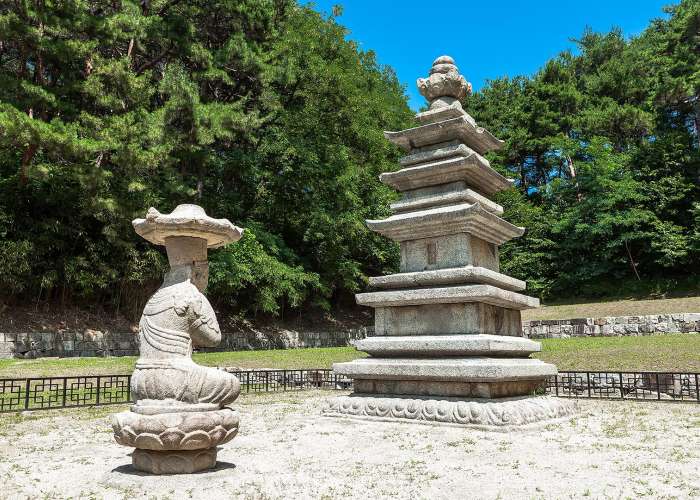
Located in Naegok-dong, Gangneung, Sinboksaji is the site of Sinboksa Temple, founded by Master Beomil. Based on the layout of the building sites and the style of the remaining Buddhist statues, it is estimated to date back to the early Goryeo Dynasty. It is a historically significant site showing stylistic changes prevalent in the Yeongdong region at that time. The site preserves the Three-story Stone Pagoda and the Seated Stone Bodhisattva, both designated as National Heritages.
Tourist Guide
Within a small temple site surrounded on three sides by tall pine forests, there are a three-story stone pagoda and a bodhisattva statue that relatively well-preserve their ancient forms. Looking at the bodhisattva statue, which has remained in one spot for a thousand years while the temple itself disappeared, evokes a sense of reverence and nostalgia. We recommend taking a mental time-travel to when these masterpieces were first created.
Tourist Tips
To reach Sinboksaji, head from Gangneung city center toward Kwandong University in Naegok-dong and enter a small path on the left before reaching the Gangneung Public Health Center. Unlike many other temple sites, the pagoda and bodhisattva here are in remarkably complete condition. Studying the styles of pagodas and statues by era beforehand will make your appreciation of our ancestors' artistic sense even more meaningful.
#조각#삼층석탑#석조보살좌상#석탑#보물#절터#고려#보살상#통일신라
-
-
Downtown
Gangneung Chodang-dong Relics
A prehistoric and ancient relic site located in Chodang-dong, Gangneung.
Introduction
This is an ancient tomb complex from around the Silla Unification War period located in Chodang-dong, Gangneung.
Tourist Guide
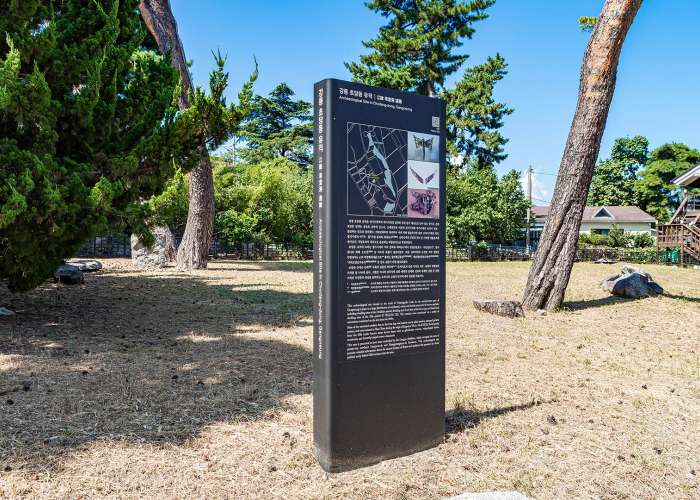
Scattered across the Chodang-dong beach area, these relics were first urgent-surveyed in 1969. Through numerous excavations, it has been confirmed as a complex site where residential areas and tombs from the Neolithic, Bronze, Iron, and Three Kingdoms periods coexist.
Tourist Tips
Designated as a National Heritage in 2007, this site covers 59,290㎡. Various artifacts such as gilt-bronze butterfly-shaped ornaments, silver belt decorations, and iron swords have been excavated from Silla-era stone-lined tombs. These findings prove the existence of powerful local forces and the geopolitical importance of the Gangneung region during the Three Kingdoms period. While fences protect the site, visitors can see where artifacts were found, covered by large stones. A nearby park allows for a relaxed visit. After exploring the history, trying Chodang's famous soft tofu is highly recommended.
#신라#해변#고분유적#발굴#사적#철검#고분#석곽묘
-
-
Downtown
Sumun-ri Dangganjiju (Flagpole Supports)
Flagpole supports with elegant lines and a simple, sturdy impression.
Introduction
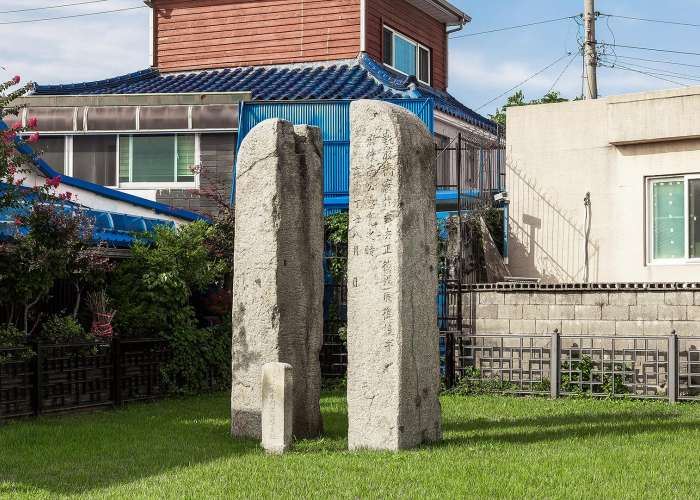
Designated as a National Heritage on January 21, 1963. These two 3.7m-tall pillars stand 1m apart, facing each other from east to west. While the surfaces lack intricate carvings, the tops are carved into elegant quarter-circle curves when viewed from the front and back, giving them a very fluid silhouette. The pillars taper slightly toward the top.
Tourist Guide
The supports feature a rectangular groove (ganggu) at the inner top to secure the flagpole. While the stone-working technique is not overly sophisticated, the semi-circular pillar heads perfectly represent the architectural style of the Unified Silla period. An inscription in regular script (haeseo) on the south side of the eastern pillar indicates that it was re-erected in 1817.
Tourist Tips
Actual "danggan" (flagpoles) are rare because they were mostly made of wood, which decays over time. However, the stone supports (dangganjiju) remain in many places. In Gangneung alone, you can find them in three locations: Daechang-ri, Sumun-ri, and Gulsansaji.
#보물#당간지주#당간#통일신라#지주#솜씨
-
-
Downtown
Gusan Seonangdang Shrine
A tangible heritage facility where the State Preceptor City Deity (Guksa Seonghwangsin) was first enshrined.
Introduction
Gusan Seonangdang Shrine is a historical site located in Seongsan-myeon, Gangneung-si, Gangwon-do. Every year on the 15th day of the 4th lunar month, after the Daegwallyeong Guksa Seonghwangje (State Preceptor City Deity Ritual) is completed, the ritual procession stops here briefly to perform an exorcism (gut) and ancestral rites before proceeding to the Daegwallyeong Guksa Yeoseonghwangsa Shrine.
Tourist Guide
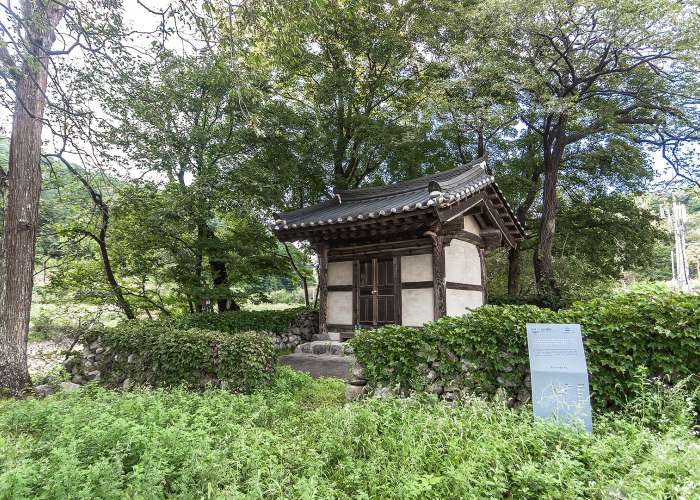
It is said that Gusan Seonangdang has existed for about 300 years. The current shrine building was newly constructed about 10 years ago and is surrounded by a stone wall. A unique feature of Gusan Seonangdang is that it enshrines the Yeongsan Jisin (Deity of the Sacred Mountain) in addition to the Seonghwang Jisin, Toji Sisin, and Yeoyeok Jisin found in other shrines. The reason Yeongsan Jisin is present is that the deity's original home on the nearby Yeongsindae hill was lost due to development, leading the deity to be enshrined here together.
Tourist Tips
Gusan Seonangdang previously faced significant inconvenience during the Gusan Seonangje ritual due to cramped surroundings and a lack of access roads. Consequently, the city of Gangneung purchased 1,213㎡ of land around the shrine to create a park and parking spaces, establishing a foundation for the transmission of the Danoje festival. This initiative also allows tourists to enjoy the Dano heritage year-round, contributing to the revitalization of local tourism. As a result, visitors can now conveniently explore Gusan Seonangdang in all seasons.
#서낭당#구산#성황제#서낭제#단오제#유적지
-
-
Gyeongpo Area
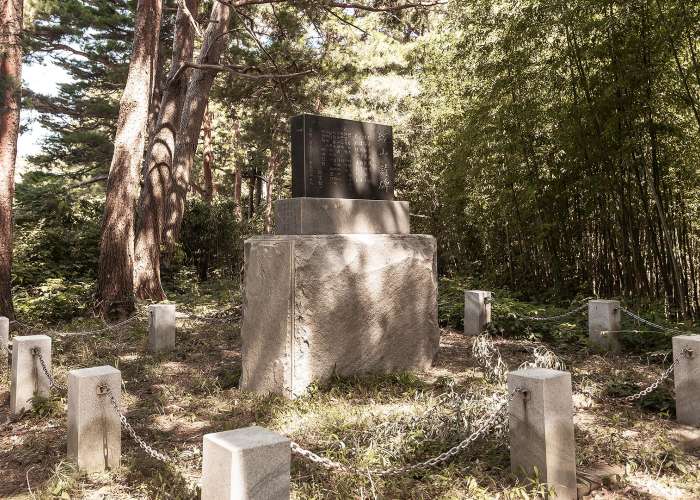
Heo Gyun Memorial Stone (Poetry Monument)
A monument honoring the artistic spirits of Gangneung’s representative writers, Heo Gyun and Heo Nanseolheon.
Introduction
Five poetry monuments honoring the artistic spirit of the five great writers of the Heo family, including Heo Gyun and Heo Nanseolheon, are erected around the site of Heo Gyun's birthplace. This area is part of a literature trail. Heo Gyun is famous as the author of the first Korean novel, 'The Tale of Hong Gildong'. Born in 1569 at Aildang in Sacheon, he had two brothers and a sister, Heo Nanseolheon. The siblings and their father are known as the "Five Great Writers of the Heo Family," leaving behind over 5,000 poems and writings.
Tourist Guide
The mountain was called Gyosan because its shape resembled a prostrate dragon (Imugi), and it is said that Heo Gyun took his pen name 'Gyosan' from it. The pine and bamboo forests surrounding the monument seem to have witnessed Heo Gyun’s turbulent life. Standing before the monument, the rustling bamboo forest feels as if it is whispering Heo Gyun’s stories, creating a solemn atmosphere.
Tourist Tips
The exact location of Heo Gyun’s birthplace at Aildang is unknown, so the monument stands at the presumed site. From Gyeongpo Beach, pass through the Sacheon pine forest and go straight toward Sacheon Harbor to find the sign. Turning left up a shallow hill leads to a parking area, and descending the hill reveals the monument. Nearby at Sacheon Beach is Gyomunam Rock, where Heo Gyun played as a child. To learn more, visit the Heo Gyun & Heo Nanseolheon Memorial Park in Chodang-dong.
#허균#시비#문학#홍길동전#애일당#교산#허난설헌
-
-
Jumunjin Area
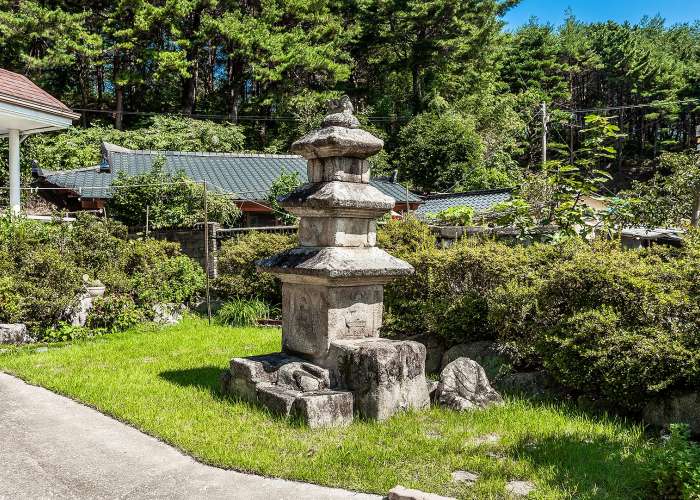
Bangnae-ri Three-story Stone Pagoda
A three-story stone pagoda featuring upper stories that decrease sharply in size.
Introduction
The Bangnae-ri Three-story Stone Pagoda is a 3.5-meter-tall structure located in Yeongok-myeon, Gangneung. Designated as a Gangwon-do Cultural Heritage on December 16, 1971, it features a single-tier base and a three-story body. The first-story body is decorated with carvings of the "Buddhas of the Four Directions." While the site is said to be the former location of Mujinsa Temple founded by Monk Jajang of Silla, the temple has since disappeared due to village development.
Tourist Guide
The pagoda stands on a small rock bed, with the base not clearly defined. Each story's body and roof stone are carved from a single piece of stone. A notable feature is the sharp reduction in the size of the body stones from the second story upward. Although legends say Monk Jajang left this pagoda here while moving Buddhist statues to Woljeongsa Temple, its architectural style suggests it was built in the early Goryeo Dynasty.
Tourist Tips
If traveling by highway, exit at the North Gangneung (Bukgangneung) Interchange. Follow National Road 7 toward Goseong (North) for about 3km until you reach the Yeongok-myeon Office. From there, take Road 6 toward the inland area to find the site.
#고려#석탑#무진사(無盡寺)#신라#삼층석탑
-
-
Downtown
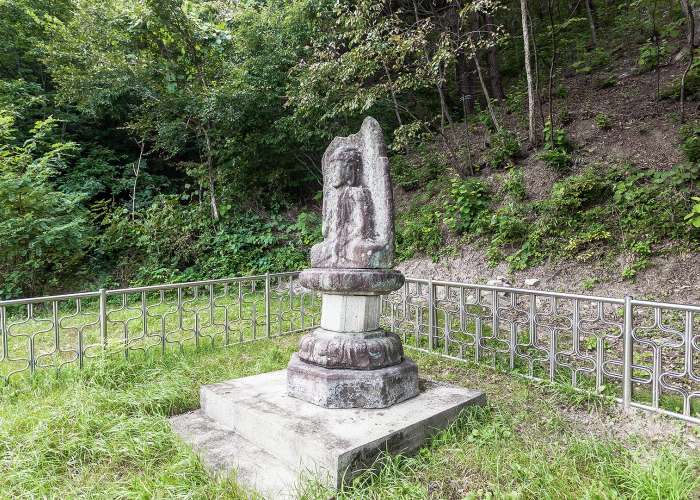
Bogwang-ri Seated Stone Buddha (Stone Seated Sakyamuni Tathagata)
A stone seated Buddha from the late Unified Silla period, complete with a pedestal and aureole.
Introduction
Standing 1.7m tall in Seongsan-myeon, Gangneung, this statue was designated as a Gangwon-do Cultural Heritage on June 10, 1992. It is located at an unnamed old temple site, though local tradition suggests a temple named Bogwangsa once stood here. It is estimated to date back to the late Unified Silla period.
Tourist Guide
The statue is noted for its overall exquisite details and excellent patterns. While the top of the aureole (nimbus) is slightly damaged, the granite form is well-preserved. It features a large usnisa (protuberance on the head) and long ears. The Buddha is seated in the lotus position, wearing a robe with clear folds over one shoulder. It is historically significant as a rare example of a statue with a full three-tier pedestal in the Gangwon East Coast region.
Tourist Tips
The jewel-shaped aureole is decorated with floral (Bosanghwa) and flame patterns. While there are traces of inscriptions on the back, they are too worn to read. The octagonal middle stone of the pedestal and the upper/lower sections decorated with lotus petals showcase the sophisticated artistic sense of the period.
#보광리#석조여래좌상#대좌#광배#사찰#통일신라
-
-
Downtown
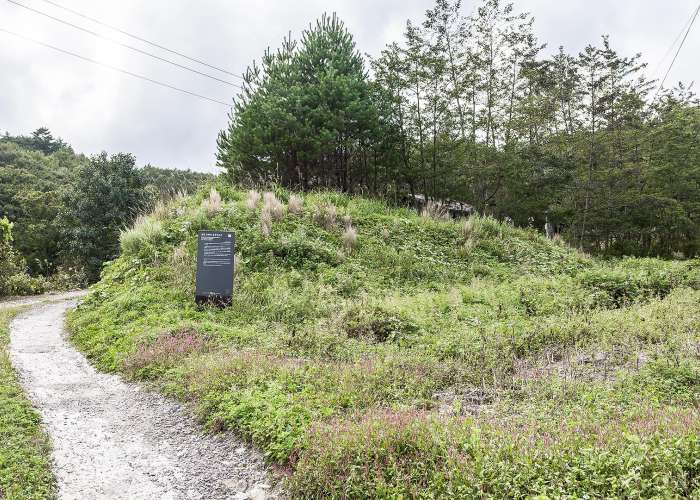
Bogwang-ri Buncheong Ware Kiln Site
The only Buncheong ware kiln site found in Gangwon-do.
Introduction
Designated as a Gangwon-do Cultural Heritage on September 23, 1994, this is the only Buncheong ware kiln site discovered in the region. Located about 1 km northwest of the Tomb of the King of Myeongju-gun, the soil in the area where the kiln is presumed to be buried is noticeably redder than the surrounding earth. The kiln's dimensions are estimated to be approximately 1.4 by 20 meters.
Tourist Guide
The lower southeastern slope, where the kiln site is believed to be, has mostly eroded, exposing the structural layers. Numerous fragments of celadon, Buncheong ware, and "dochim" (pottery supports used during firing) are scattered around the area. Most of the recovered fragments are from bowls and plates.
Tourist Tips
Fragments found at the site include bowls with black inlaid lotus and vine patterns, as well as plates with stamped chrysanthemum designs. Based on these patterns, the site is identified as a kiln active from the 13th to the early 15th century. A small number of white porcelain fragments have also been recovered.
#보광리분청자요지#강원도기념물#가마터#분청사기#유구층(遺構層)#청자#도자기
-
-
Jumunjin Area
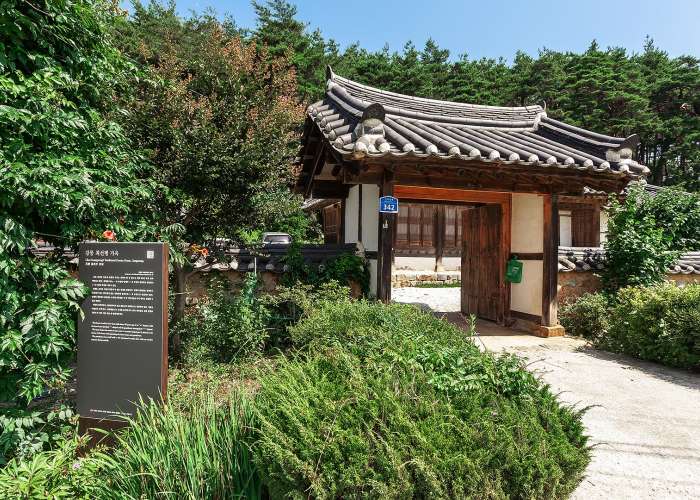
Choe Seon-pyeong Gaok (Traditional House of Choe Seon-pyeong)
A traditional "ㅁ"-shaped house featuring a harmony of hip-and-gable and gable roofs.
Introduction
Located in Jangdeok 1-ri, Jumunjin, this house was designated as a Gangwon-do Cultural Heritage on January 17, 1985. While the exact construction date is unknown, it features a traditional courtyard layout. The main house (Anchae) and guest house (Sarangchae) have hip-and-gable roofs, while the other sections have gable roofs. It stands on natural stone foundations with trapezoidal granite plinths. Although modernized with an indoor kitchen and expanded rooms, it preserves its historical value.
Tourist Guide
The main house is 4 units wide and 2 units deep. On the right, there is a kitchen with a warehouse and stable built at a slightly lower level. The guest house features a wooden-floored hall (Daecheong) with a specialized ceiling (Nunseop-cheonjang) and paneled walls. The windows and doors are intricately designed with traditional lattices and ventilation hatches that can be opened and closed.
Tourist Tips
The house uses double doors (sliding and lattice) between rooms for better insulation. To protect the exposed wooden structures from wind and rain, windboards (Pungpan) are attached to the sides. Pay attention to the decorative panels (Gungpan) and the structural supports (Boaji) on the guest house pillars, which add a unique aesthetic touch to the sturdy architecture.
#최선평가옥#주문진읍#옛집#창호#퇴청
-
-
Jeong Dong Jin, Okgye
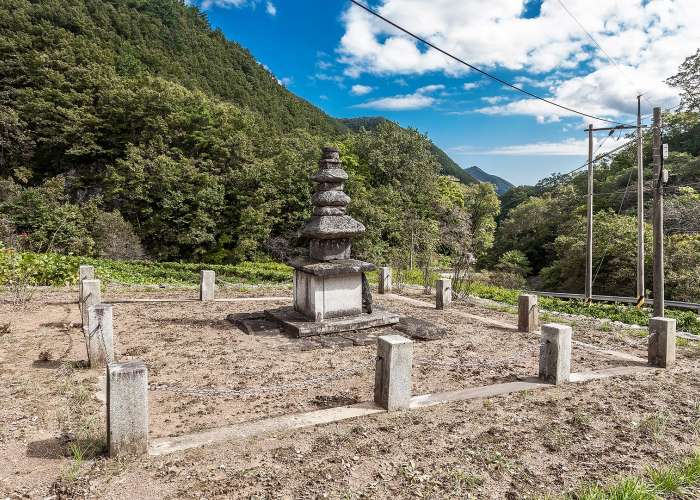
Sangye-ri Three-story Stone Pagoda
A Goryeo-era three-story stone pagoda reconstructed from scattered fragments found at an ancient temple site.
Introduction
The Sangye-ri Three-story Stone Pagoda is a reconstruction of collapsed pagoda fragments found at a temple site in Okgye-myeon. Based on its style, it is estimated to date back to the Goryeo Dynasty. The site was identified as an ancient temple due to the large amount of ash found nearby. Most of the original base has been lost, but the upper stories remain relatively well-preserved despite significant weathering.
Tourist Guide
Located where the paved valley road ends and the mountain trail begins in Sangye-ri, this pagoda greets visitors with its uniquely dark and rugged silhouette. Although worn by time and modified through reconstruction, the pagoda evokes a deep sense of history and the endurance of past eras.
Tourist Tips
Reaching Sangye-ri requires a long drive up mountain roads toward Daegwallyeong from Okgye. To make the most of your trip, it is recommended to visit nearby attractions such as Waryong Valley, Swingil Waterfall, Okgye Cave, and Okgye Beach.
#산계리#고려#석탑#세월#문화#절터
-
-
Downtown
Daegongsanseong Fortress
Said to have been built by Onjo, the founder of Baekje, to train his troops.
Introduction
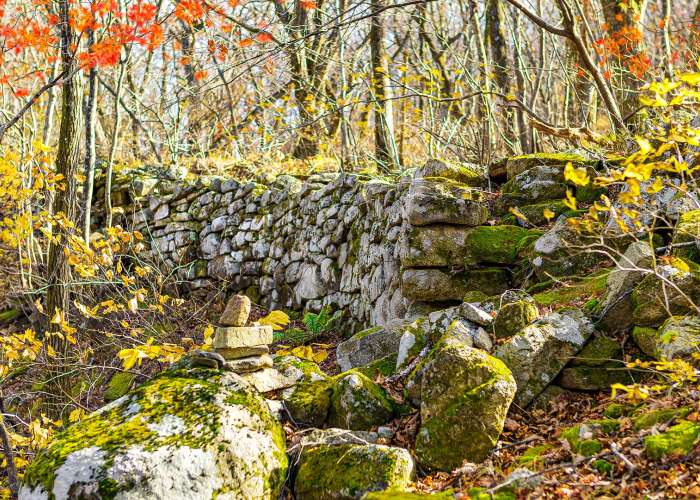
Daegongsanseong Fortress is located in Bogwang-ri, Seongsan-myeon, Gangneung, with a perimeter of about 3,000 meters. Currently, the sites of the East, West, and North gates remain along with parts of the fortress walls. It is also known as Bohyansanseong or Daegungsanseong, though the exact date of construction is unknown. While some say King Onjo of Baekje built it for military training, others claim it was named after the Dae clan of Balhae who supposedly constructed it.
Tourist Guide
Designated as a Gangwon-do Cultural Heritage on May 30, 1979, the fortress was built using natural stones. Although much of it has collapsed, stone wall traces of about 2 meters and gate sites still exist. It is also famous as a fierce battlefield where righteous armies led by Min Yong-ho fought against Japanese forces during the Eulmi Righteous Army movement in 1894.
Tourist Tips
Follow the mountain path on the right before reaching the entrance of Bohyeonsa Temple to find the fortress. It is a stone fortress spanning about 4km. Records refer to this place as Bohyansanseong. The northern wall utilized steep cliffs and is mostly ruined, while the southern part retains walls made of unrefined stones. Inside the fortress, there is a well site said to have been built 1,000 years ago.
#기념물#성벽#온조왕#산길#을미의병#산성
-
-
Downtown
Samojung Park
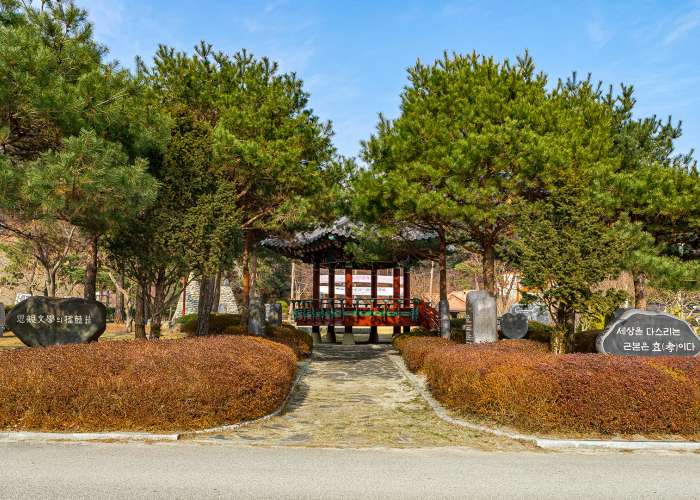
Samojung Park was established to emphasize filial piety and love as the fundamental values of humanity.
Introduction
Samojung Park was established to emphasize filial piety and love as the fundamental values of humanity. Samojung and the Filial Piety Park embody sentiments that honor mothers and the nostalgia of old hometown villages. The Samojung Pavilion is elegantly and traditionally designed, exuding a refined and dignified appearance, while the Filial Piety Park serves as a cultural space of high prestige. Notably, the park highlights the scholarship, artistic achievements, and filial devotion of prominent figures from the Gangneung region, such as Shin Saimdang and Yi Yulgok, solidifying its status as a birthplace for promoting the globalization of filial piety.
Tour guide
In the southern area of Filial Piety Park, Samojung Pavilion, poetry monuments, and sculptures are arranged, while along the northern edge, stone engravings and poetry monuments honoring the filial deeds of the "Filial Spirit of Gangneung" residents are set up like a folding screen. Notably, stone inscriptions provide information commemorating the virtuous deeds of local figures Shin Saimdang and Yi Yulgok. Along the western edge of the park, two Motherly Love Towers have been erected.