-
-
Gyeongpo Area
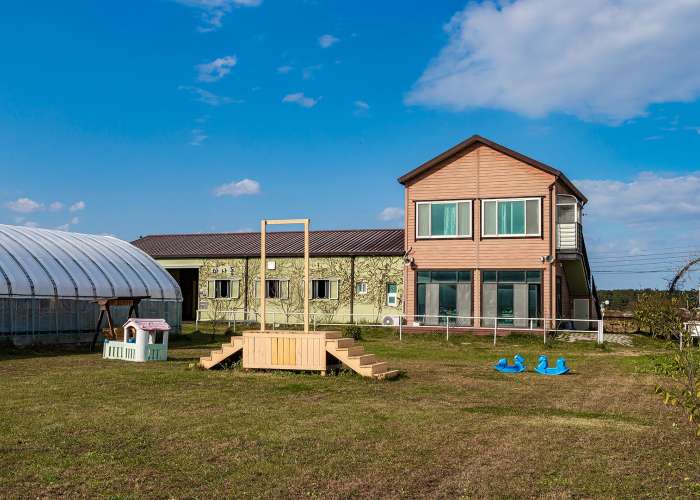
Gangneung Baby Animal Farm
Animal Feeding Experience, Pony Land, Animal Therapy
Introduction
Gangneung Baby Animal Farm is a tourist ranch (rural educational farm) that aims to provide children with opportunities to observe animals and plants in their natural environments and to help them develop an appreciation for the value of life through hands-on experiences.
Tourist Guide
Located near Sacheon Beach in Gangneung, Gangneung Baby Animal Farm is one of the must-visit attractions in the area. Visitors can meet and interact with a variety of friendly animals such as guinea pigs, goats, ponies, rabbits, parrots, dogs, and cats. The farm also features a spacious parking lot for convenient access. The admission fee includes an animal feeding experience, and each visitor can take home a cute succulent plant.
Travel Tips
Gangneung Baby Animal Farm is within walking distance of Sacheon Beach, making it easy to include in your travel itinerary.
-
-
Gyeongpo Area
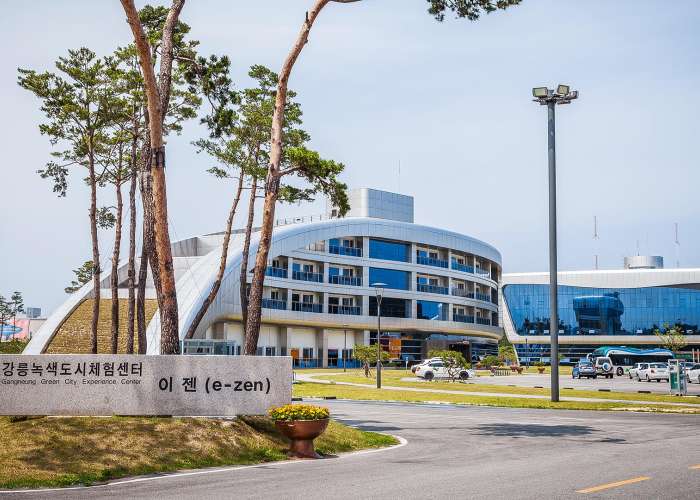
Gangneung Green City Experience Center
A variety of hands-on experience programs available
Introduction
Operated using renewable energy, the Gangneung Green City Experience Center is the nation’s first eco-friendly facility where visitors can explore a green city. From the grassy lawn at the entrance to the streetlights, eco-friendly technologies have been applied throughout the entire site. Visitors can directly see and experience energy generated from nature, offering an opportunity to reflect on the importance of the natural environment.
Tourist Guide
The Green City Experience Center consists of an integrated convention center and an experiential training center. It hosts a variety of educational and exhibition programs, including an experiential exhibition hall with frequently changing themes and hands-on environmental education classes. At the experiential training center, which features a lake garden and accommodations, rooms are provided at a set fee exclusively for participants in the programs. The center also operates various experiential programs designed to spark interest in environmental education, such as the Green System Tour, Eco Tour, Green Academy, and Green Weekend Experience. The Eco Tour is an activity where visitors ride an electric bus called “Chorok-i,” powered by an electric motor instead of fossil fuels, to visit nearby green city project sites, tourist attractions, and cultural heritage locations.
Travel Tips
The Green City Experience Center is composed of an integrated convention center and an experiential training center. The convention center is surrounded by walls fitted with solar power panels, a form of renewable energy. The energy generated here is used to operate the building. As a self-sufficient eco-friendly energy building, its most distinctive feature is that visitors can directly observe and experience energy obtained from nature. Children can also enjoy and learn about the environment in a fun and engaging way. With advance reservations, visitors can enjoy a tour riding an eco-friendly electric bus to and from an art museum. Please note that the center is closed on Mondays. Through the Green System experience tour in Gangneung, visitors can learn about the city’s history, culture, and environment. A wide range of hands-on programs are available, making it enjoyable for both adults and children. Nearby, the Heo Gyun and Heo Nanseolheon Memorial Park is located, and a visit is highly recommended.
-
-
Downtown
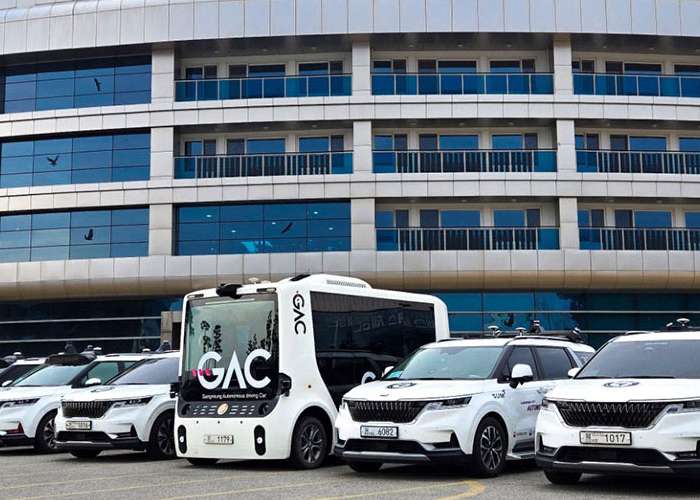
Autonomous Tourist Vehicle
The “Gangneung Autonomous Tourist Vehicle” is the only autonomous driving experience service offered in Gangwon Province.
Introduction
The “Gangneung Autonomous Tourist Vehicle” is the only autonomous driving experience service offered in Gangwon Province. It provides easy access to Gangneung’s iconic tourist spots, including Gangneung Station, the intercity and express bus terminals, Ojukheon, Chodang, Gangmun, and Anmok Beach.
Tourist guide
The Gangneung Autonomous Tourist Vehicle operates free of charge on a same-day reservation system. Reservations can be made through the Gangneung City website or the tourism website reservation portal. Visitors can also scan QR codes at autonomous vehicle stops to access the booking site. For those who have difficulty using mobile devices, a call center is available at 1668-2115.
Tourist Tips
The service runs on three routes—A, B, and C—as follows:⦁Route A: Circulates between Gangneung Station, the bus terminal, Ojukheon, and the Olympic Museum. (Carnival vehicle, max 5 passengers)⦁Route B: Shuttle service between the Olympic Museum, Green Experience City (Metaverse Experience Center), and Chodang (Gangmun). (Shuttle-type vehicle, max 8 passengers)⦁Route C: Shuttle route between Ojukheon, Gyeongpodae, Gyeongpo Lake, Songjeong, and Anmok Beach. (Carnival vehicle, max 5 passengers)All routes are interconnected, allowing passengers to transfer and explore all major Gangneung tourist attractions from Gangneung Station and the terminals all the way to Anmok Beach.
-
-
Downtown
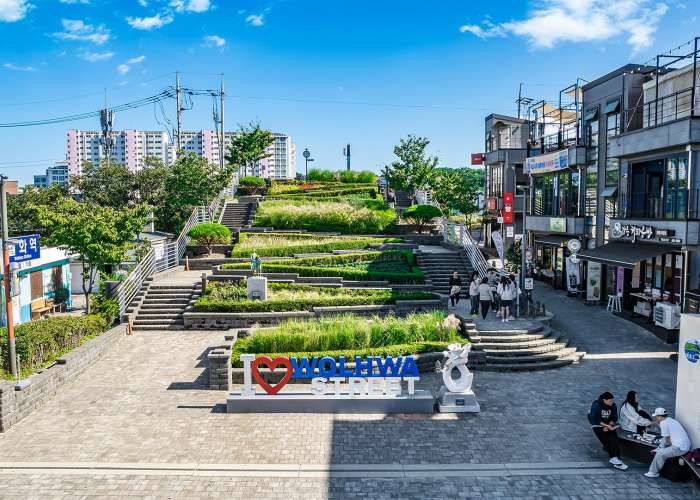
Wolhwa Street
Wolhwa Street is an urban park created along a former railway line in downtown Gangneung.
Introduction
Wolhwa Street is an urban park created along a former railway line in downtown Gangneung. The name “Wolhwa” comes from the poignant local legend of Muwollang and Lady Yeonhwa, a love story that inspired Korea’s famous classic “Chunhyangjeon.” With a rich narrative and inviting atmosphere, this charming street is a place everyone wants to walk, filled with delicious food, performances, and exhibitions.
Tourist guide
Wolhwa Street stretches 2.6 kilometers from Gangneung Station to Buhung Village, transformed into a themed linear park. At its entrance is “Mal Nanumteo Park,” followed by “Imdang Square,” also known as the Folk Market. Further along, the Historical and Cultural Plaza sits beside Homeplus, and the area near Jungang and Seongnam Markets is known as the Living Culture Plaza. Each section offers a unique experience that reflects the daily life, history, and traditions of Gangneung.
Tourist Tips
The name "Wolhwa" originates from a local Gangneung folktale—the heartbreaking love story of Muwollang, a descendant of King Taejong Muyeol of Silla, and Lady Yeonhwa. According to the tale, a pavilion once stood on a rock cliff near Yeonhwa Peak along the Namdaecheon River. It was named Wolhwajeong (Moon-Flower Pavilion), combining characters from their names: “Wol” (moon) from Muwollang and “Hwa” (flower) from Lady Yeonhwa.Although the original pavilion was swept away by a great flood in 1936, a marker stands on the original site, and a reconstructed version can be visited today.As you walk along the 2.6km Wolhwa Street, you'll encounter themed areas such as parks, plazas, and cultural spaces—perfect for exploring Gangneung’s past and present while enjoying scenic walks, tasty bites, and local arts.
#폐철도길#음식#무월랑#전시#거리공원#연화부인
-
-
Gyeongpo Area
Nature, Let’s Play Experience Learning Museum
A space where you can see and observe insects, fish, birds, reptiles, and mammals
Introduction
“Nature, Let’s Play Experience Learning Museum” is located in Ponam-dong, Gangneung. It is a museum where children can create special memories through ecological experiences by seeing, hearing, and feeling various living creatures. The museum offers exhibition programs featuring a wide range of organisms, allowing hands-on learning experiences with insects, reptiles, mammals, and crustaceans.
Tour Guide
“Nature, Let’s Play Experience Learning Museum” is a place where visitors can directly experience nature using all five senses, with opportunities to see and touch various insects and animals right before their eyes. It opens at 10:00 AM on both weekdays and weekends and closes at 6:00 PM. Children under the age of 3 are admitted free of charge. Group discounts are available, so group visitors are advised to inquire by phone before visiting.
Travel Tips
At the entrance of the museum, various kinds of fish welcome visitors. The familiar orange-and-yellow striped fish you see upon entering is the clownfish. This fish is well-known because it appears in the animation “Finding Nemo.” In addition to clownfish, there are many species of fish that are rarely seen in everyday life. One particularly unique fish is the axolotl, often seen only on TV; it has both arms and legs, capturing the interest of not only children but adults as well. Another notable fish is the pirarucu, known as the king of freshwater fish from the Jurassic era, featuring a long and distinctive appearance.The museum also offers hands-on programs, including an experience with “doctor fish” that feed on dead skin cells. Visitors can also gently touch and pet small and adorable lizards. The albino boa constrictor, featured in “The Little Prince,” offers a special experience for those familiar with the story. Visitors can place the albino boa around their neck or touch it, allowing them to feel its body warmth.Finally, the museum houses the world’s largest spider, the tarantula. Although its black, hairy appearance may seem intimidating, encountering it can be a fascinating and unique experience. In addition, visitors can touch and learn about various other creatures such as rabbits, hamsters, weasels, frogs, and beetles.
-
-
Gyeongpo Area
Solbaram Bridge
A bridge connecting Gangneung Port and Namhangjin
Overview
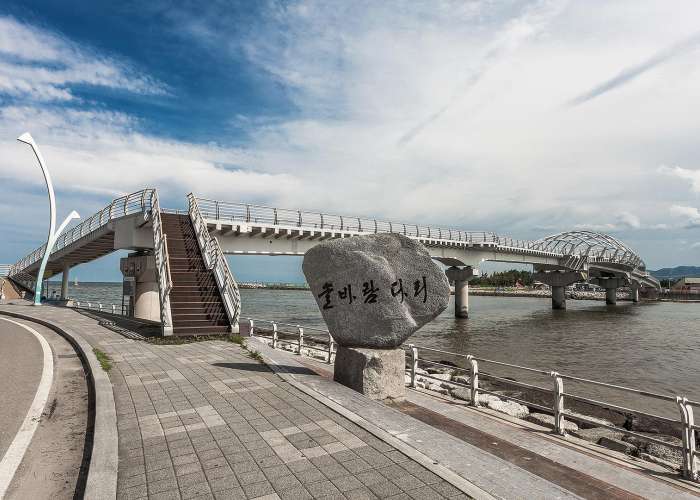
Solbaram Bridge, a pedestrian bridge connecting Namhangjin and Anmok, was completed on April 9, 2010, and has a total length of 192 meters. Due to its location between the sea and the river, strong winds are common, which makes it a popular destination, especially during the summer. At night, the bridge is illuminated, creating a beautiful night view that attracts many visitors.
Tourist Guide
Solbaram Bridge is located where the Namdaecheon Stream, which flows through downtown Gangneung, meets the East Sea. Its name is as charming as its shape. The bridge connects Anmok Beach, famous for its coffee culture, and Namhangjin Beach. Standing on the bridge, you can enjoy a panoramic view of the vast ocean horizon stretching out before your eyes and fully experience the refreshing sea breeze.
Travel Tips
At both ends of Solbaram Bridge, breakwaters made of tetrapods have been constructed to prevent erosion caused by waves, and the surrounding areas are often bustling with people enjoying sea fishing. As this area is known for frequent winds, it is advisable to wear wind-resistant clothing when visiting. Toward Anmok Beach, which is connected by Solbaram Bridge, lies Gangneung Port. From the Gangneung Passenger Terminal located here, ferries operate round trips to Jeodong Port on Ulleungdo Island. When viewed from above, Gangneung Port features breakwaters shaped like two crab claws extending toward the sea. Before being renamed Gangneung Port, it was known as Anmok Port. At the ends of the two breakwaters stretching into the sea stand a white lighthouse and a red lighthouse facing each other. At night, the two lighthouses glow warmly as if keeping each other company. The sea breeze experienced on Solbaram Bridge feels incredibly refreshing, as if the scent of pine trees—symbolic of Gangneung—is carried in the wind. Around the bridge, both locals and visitors can be seen strolling and enjoying the cool sea breeze under the warm sunlight. Here, you can experience a unique charm found only in this place.
-
-
Downtown
Jeongdongjin Rail Bike
Jeongdongjin Rail Bike is one of the highlights of travel in Gangwon Special Self-Governing Province and attracts many tourists.
Introduction
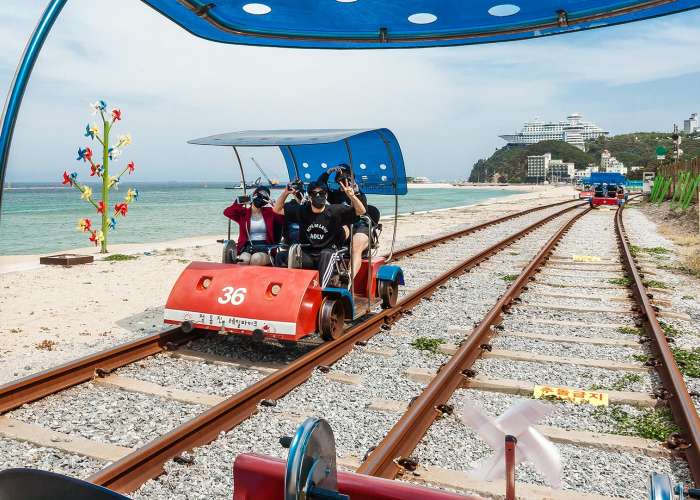
Jeongdongjin Rail Bike is one of the highlights of travel in Gangwon Special Self-Governing Province and attracts many tourists. Starting from Jeongdongjin Station, the rail bike route offers refreshing sea breezes and scenic ocean views, creating memorable experiences for couples and families alike.
Tourist guide
Access to the Jeongdongjin Rail Bike requires purchasing a ticket. Discounts are available for group tourists, Gangneung residents, and soldiers from the 23rd Division, but discounted tickets must be bought at the onsite ticket booth. The rail bikes come in two types: two-seater and four-seater. Additionally, package deals are offered that combine rail bike rides with visits to nearby museums and attractions in Gangneung, providing a cost-effective way to enjoy multiple experiences.
Travel Tips
The rail bikes are electric-assisted, making them easy to ride for seniors and those with limited mobility. Riders who want to go faster should sit in the rear seat, as pedaling speed increases velocity. The two-seater model is ideal for couples or close friends, featuring pedal operation by both riders using their feet. The four-seater is suited for families or groups, with front-seat riders pedaling by hand and rear-seat riders pedaling by foot.
#정동진역#레일바이크#해변#전동운행#추억#바다#레저스포츠
-
-
Daegwallyeong
Daegwallyeong Baby Animal Farm
Animal feeding experience and observation of plants and animals
Introduction
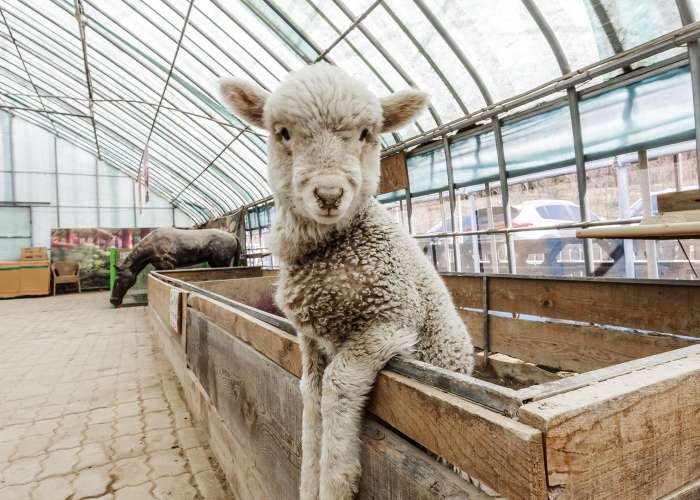
“Daegwallyeong Baby Animal Farm” is a joyful animal farm where visitors can freely feed animals, observe them up close, and enjoy playing together in a pleasant and friendly environment.
Tourist Guide
This is a baby animal farm in Gangneung where you can see adorable alpacas. Upon entry, visitors are provided with free snacks to feed the animals, and hay placed around the animal enclosures can also be freely given to them.In addition, there are five large, well-ventilated indoor houses, allowing visitors to enjoy the experience comfortably even on rainy days.The outdoor play area features not only animals but also a variety of flowers and fruit trees, enabling visitors to appreciate seasonal blossoms and fruits throughout the year.
Travel Tips
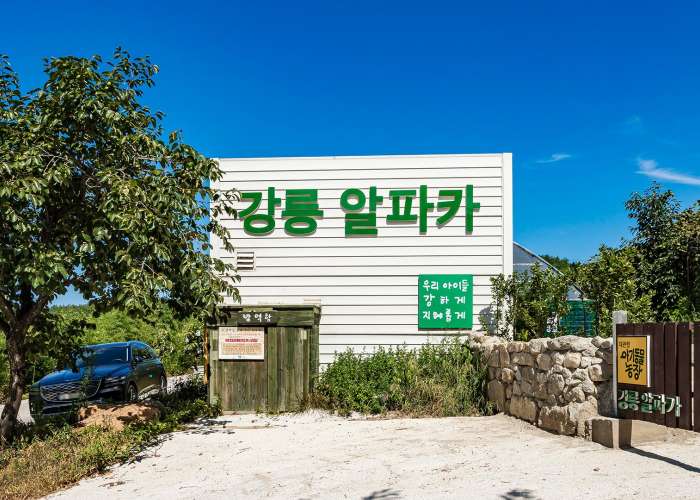
Daegwallyeong Baby Animal Farm is located across from the Gangneung Driver’s License Test Center in Sacheon-myeon. If the location does not appear on your navigation system, search for “Gangneung Driver’s License Test Center” and follow the directions to reach the farm.
#동물#아기동물농장#알파카#체험#동물농장#먹이주기#가족여행
-
-
Gyeongpo Area
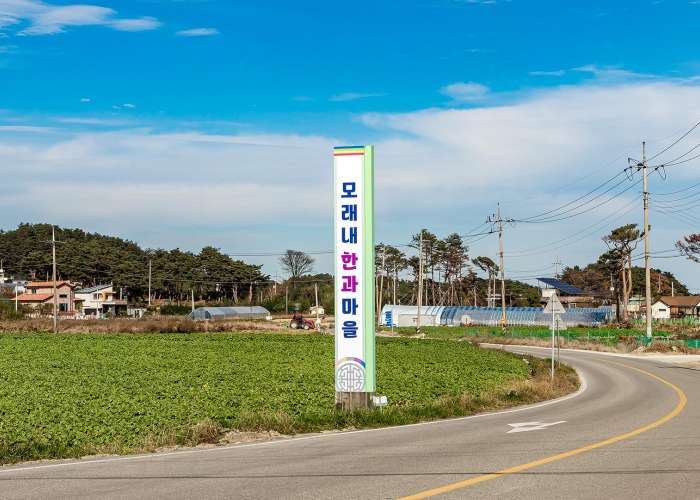
Moraenae Hangwa Village
A hands-on village where you can experience making traditional Korean hangwa
Introduction
When people think of “hangwa” (traditional Korean sweets), many recall Gangneung. In times when sweets were rare, our ancestors devoted extraordinary care to making even a single piece, spending days and nights boiling malt syrup, carefully selecting high-quality glutinous rice and fragrant sesame seeds, and crafting hangwa with utmost dedication.Gangjeong, known for its crispy texture, is made by fermenting and drying glutinous rice flour, mixing it with alcohol and boiling water to form a dough, then cutting it into appropriate lengths and drying it. It is then deep-fried in oil and coated with honey or grain syrup, and finally covered with sesame seeds, soybean powder, pine nut powder, or pine pollen powder to enhance both taste and appearance.Gwajul is a traditional confection made from a glutinous rice base and decorated with puffed rice coating. As consumer preferences shifted toward healthier foods, Moraenae Hangwa Village was designated as Traditional Food No. 2 by the Ministry of Agriculture in 1995. Since then, it has produced five types of products including sesame gangjeong, exporting them overseas—including to the United States—thus contributing to national prestige and regional economic development. The village has received the Korean Government Industrial Medal and gained nationwide recognition as a traditional hangwa village.Sacheon-myeon in Gangneung was originally called “Moraenae,” meaning “sandy stream,” due to the sandy river flowing through the area. Once a poor rural village just 30 years ago, it has transformed by preserving 130 years of traditional hangwa-making techniques. Through participation in the “One Village, One Specialty Product” initiative, the entire village now produces hangwa using traditional methods, becoming the renowned Moraenae Hangwa Village.
Tour Guide
Gangneung Moraenae Hangwa Village was designated as a Traditional Food Preservation Village in 1989, an Information Model Village in 2001, and an Outstanding Village in the New Rural Community Movement. It continues to actively produce hangwa today.While Korean food culture is increasingly westernized in appearance and taste, Moraenae Hangwa maintains its authenticity by using clean, self-produced glutinous rice for all ingredients except frying oil. Without automated or mass production facilities, the village preserves a traditional cottage industry approach, producing only limited quantities. This is the very strength that upholds the tradition and excellence of hangwa. It is truly a traditional Korean confection imbued with the spirit of craftsmanship.
Travel Tips
Gangwon State is a region known for upland farming, where staple foods traditionally included corn rice, potato rice, potato dumpling soup, and buckwheat noodles made from field crops such as corn, potatoes, and buckwheat. Hangwa was also commonly made from these crops.Moraenae Hangwa Village was originally a farming community, but as hangwa production increased, it became the main industry while farming became secondary. The village uses locally grown agricultural products as primary ingredients and established its own grain syrup factory, ensuring that only pure grain syrup is used. This results in its exceptional taste.There is even a saying that once you taste hangwa from Moraenae Village in Gangneung, you cannot enjoy hangwa from elsewhere. This is because the grain syrup used differs from common malt syrup in both taste and production process; using regular malt syrup does not produce the authentic flavor of hangwa.Gangneung is especially famous for gwajul, thanks to the dedicated efforts of local residents. By building a grain syrup factory and striving for better taste, they have produced superior-quality gwajul. They have also improved distribution systems, transitioning from offline sales to both online and offline channels, as well as exports overseas, making Gangneung hangwa even more widely known.Through these efforts, Moraenae Hangwa has become a distinguished regional specialty with unique characteristics, attracting visitors from around the world. The residents of Moraenae Village cherish their ancestral heritage and continuously strive to further develop their traditions, making the village all the more charming and admirable.The area surrounding Moraenae Village in Gangneung also offers plenty of attractions, including beaches, recreational forests, and literary museums. The nearest beach, Sacheon Beach, is known for its high-quality sand and clean water, attracting visitors year-round.Although less widely known than Sacheon Beach, Hapyung Beach is popular among family travelers. It was named after Heo Bong, the second son of Heo Yeop, who once lived there. The beach features a stretch of white sand connected to Dwitbul Beach and a wide forest of pine trees behind it, offering a quiet and clean environment.Visitors who come to Gangneung to enjoy the sea will likely think of hangwa as they walk along the white sandy shores. While hangwa makes an excellent gift or snack, we recommend visiting Moraenae Hangwa Village to experience the delight of tasting freshly made hangwa on-site.